
On This Page
Imagine you want to send a private message to someone over the internet. The problem? The internet is fundamentally a public network, filled with intermediaries: your internet service provider, routers, servers, and countless other systems that relay your data from point A to point B. How can you ensure that your message remains truly private?
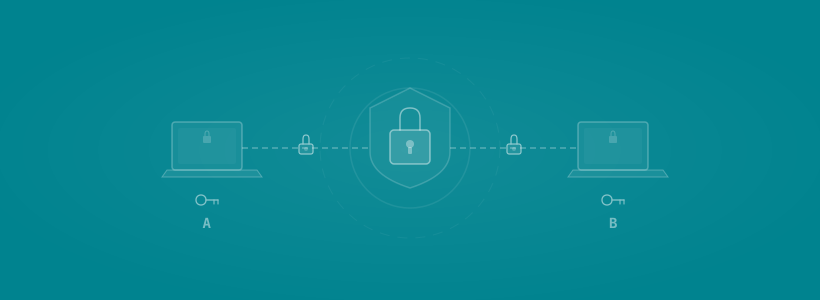
This is where end-to-end encryption (E2EE) comes in. At its core, E2EE ensures that only the sender and the intended recipient can read the message. No one else, not even the service provider facilitating the communication, can access the content.
Not All Encryption Is Created Equal
Before diving into how E2EE works, it’s crucial to understand what it is NOT. Many services claim to be “secure” or “encrypted,” but encryption comes in different forms, and not all of them provide the same level of protection.
Encryption in Transit
This protects data while it travels across the network. The most common example is TLS/HTTPS, which encrypts your communication with a website. However, the server receives and can read the decrypted data. It can analyze it, store it, process it, or even share it. Your data is protected from eavesdroppers on the network, but not from the service provider itself.

Encryption at Rest
This protects data when it’s stored on disk or in a database. For instance, a company might encrypt its database so that if someone steals the physical hard drives, they can’t read the data. But here’s the key point: the server has the decryption key. When the application needs to access the data, it decrypts it. The service provider can read your stored information.

In Transit + At Rest ≠ End-to-End
Even when combined, these two types of encryption do NOT constitute end-to-end encryption. Why? Because at some point, the server has access to the content in plaintext (unencrypted form). This makes your data vulnerable if:
- The server is compromised by hackers
- The company is served with a legal request to hand over data
- A rogue employee abuses their access
- The service provider decides to read or monetize your data
This isn’t just about trust. Even if you fully trust the service provider’s intentions, their access to your data creates systemic risk. When servers can access your data (either stored in plaintext or encrypted with keys they control), they become high-value targets. A breach at the service provider compromises not just their systems, but all their users’ data. This is a supply chain security problem: you’re only as secure as the weakest link in the chain, and centralized data access creates a single point of failure for millions of users.

True End-to-End Encryption
With authentic E2EE, only the sender and recipient possess the keys needed to decrypt the messages. The server only ever sees encrypted data that it cannot decrypt. Even the service provider cannot access the content of your communications.
Think of it like a padlock. The recipient gives you their open padlock but keeps the key. You put your message in a box and close the padlock. Once closed, even you cannot open it anymore since you don’t have the key. The postal service transports the locked box. Only the recipient can open it with their key. The postal service can only deliver, never read the content.
This distinction matters immensely for real privacy: protection against surveillance, legal subpoenas, server breaches, and untrustworthy service providers.

Symmetric Encryption: One Key for Everything
To understand how E2EE works, we need to start with the basics: symmetric encryption.
Symmetric encryption uses the same key to both encrypt and decrypt data. Think of it like a safe with a combination: the same combination locks it and unlocks it.
In practice, symmetric encryption algorithms like AES (Advanced Encryption Standard) are extremely fast and efficient. They can encrypt massive amounts of data with minimal computational overhead. This is why symmetric encryption is used to protect everything from full disk encryption to secure file storage.
Symmetric encryption is perfect… until you encounter one fundamental problem.

The Key Distribution Problem
Here’s the catch: how do Alice and Bob agree on that shared secret key in the first place?
Let’s set the scene. Alice wants to communicate securely with Bob. They’ve never talked before. All their communications must pass through an untrusted public network where attackers might be watching every message.
Naive attempt 1: Alice sends the key in plaintext. Result: An attacker intercepts it. Game over.
Naive attempt 2: Alice and Bob meet in person to exchange keys. Result: Not scalable. Imagine doing this for every website you visit or every person you message.
Naive attempt 3: They trust a third party to distribute keys. Result: That third party becomes a single point of failure. If compromised, all communications are exposed.
This is the classic paradox: you need a secure channel to establish a secure channel. For decades, this seemed like an unsolvable chicken-and-egg problem. Then, in the 1970s, a revolutionary idea emerged that would change cryptography forever.
Asymmetric Encryption: The Two-Key Revolution
Asymmetric encryption, also called public-key encryption, introduced an elegant solution: instead of one key, use two mathematically related but distinct keys.
- Public key: Can be shared with anyone, published openly
- Private key: Kept secret, never shared
The mathematical magic is this: what you encrypt with the public key can only be decrypted with the corresponding private key. The function works easily in one direction but is computationally infeasible to reverse without the private key.
Common asymmetric algorithms include RSA and algorithms based on elliptic curves (like ECDH and ECDSA). They rely on hard mathematical problems, like factoring the product of two large prime numbers (RSA) or solving the discrete logarithm problem on elliptic curves (ECC).
How It Works in Practice
- Bob generates a key pair: a public key and a private key
- Bob publishes his public key openly (on a website, in a directory, anywhere)
- Alice encrypts her message using Bob’s public key
- Only Bob, with his private key, can decrypt and read the message
This is transformative. Alice and Bob never needed to meet. They never needed to exchange secret information. Bob simply published his public key, and secure communication became possible.

The Limitations
Asymmetric encryption solves the key distribution problem, but it comes with trade-offs:
- Much slower: Asymmetric operations are computationally expensive, often 100-1000x slower than symmetric encryption
- Resource-intensive: Requires more CPU and memory
- Message size limits: Can only encrypt small amounts of data directly
For encrypting a large video file or streaming a video call, asymmetric encryption alone would be impractically slow. This is where the next concept becomes crucial.
Diffie-Hellman: Creating a Shared Secret Without Transmitting It
We’ve established that symmetric encryption is fast but has a key distribution problem. Asymmetric encryption solves distribution but is too slow for bulk data. What if we could use asymmetric cryptography to securely establish a symmetric key?
The Diffie-Hellman key exchange protocol does exactly this. It allows two parties to collaboratively generate a shared secret key over an insecure channel without ever transmitting that secret.
Here’s the key insight: even if an attacker observes every message exchanged during the process, they cannot compute the shared secret.
How Diffie-Hellman Works
Let’s walk through the protocol step by step:
Step 1: Public Agreement Alice and Bob publicly agree on two numbers:
- p: a very large prime number
- g: a generator (a specific number with certain mathematical properties)
These numbers are public. Everyone can know them, including attackers.
Step 2: Private Secrets
- Alice picks a random secret number: a (keeps it private)
- Bob picks a random secret number: b (keeps it private)
Step 3: Public Exchange
- Alice calculates A = gᵃ mod p and sends A to Bob
- Bob calculates B = gᵇ mod p and sends B to Alice
These values A and B are sent over the public network. An attacker can see them.
Step 4: Secret Computation
- Alice receives B and calculates: s = Bᵃ mod p
- Bob receives A and calculates: s = Aᵇ mod p
Mathematically, both calculations produce the same result:
- s = (gᵇ)ᵃ mod p = (gᵃ)ᵇ mod p = g⁽ᵃᵇ⁾ mod p
Alice and Bob now share the secret s, which they can use as a symmetric encryption key. They never transmitted s over the network.

Why This Works
The security of Diffie-Hellman relies on the computational difficulty of the discrete logarithm problem. Given g, p, and A = gᵃ mod p, it’s extremely hard to figure out what a was. Computing gᵃ mod p is easy. Reversing it to find a is not.
An attacker sees:
- p (public)
- g (public)
- A = gᵃ mod p (observed on network)
- B = gᵇ mod p (observed on network)
But without knowing a or b, the attacker cannot compute s = g⁽ᵃᵇ⁾ mod p.
Critical Limitations
While Diffie-Hellman is powerful, it has important weaknesses:
No authentication: The protocol doesn’t verify who you’re talking to. An attacker could perform a man-in-the-middle attack:
- Attacker intercepts Alice’s messages, performs DH with Alice
- Attacker intercepts Bob’s messages, performs DH with Bob
- Attacker now shares one key with Alice, another with Bob
- Attacker can decrypt, read, modify, and re-encrypt all messages
This is why Diffie-Hellman must be combined with authentication mechanisms, like digital signatures or certificates, to verify the identity of the parties involved.
Hybrid Encryption: Combining the Best of Both Worlds
Now we can bring it all together. The optimal approach combines asymmetric and symmetric encryption in what’s called hybrid encryption:
- Use asymmetric cryptography for key exchange: Solve the key distribution problem using techniques like Diffie-Hellman or RSA
- Switch to symmetric encryption for data: Use the established symmetric key (called a session key) to encrypt all actual communications
This strategy is optimal because:
- Performance: Symmetric encryption handles the bulk of the data efficiently
- Security: Asymmetric cryptography solves the initial key distribution problem
- Practicality: No pre-shared secrets required, works between strangers
Typical Hybrid Flow
- Alice and Bob establish their identities (using public/private key pairs)
- They perform a key exchange (using Diffie-Hellman or similar)
- This produces a shared symmetric session key
- All subsequent messages are encrypted with this fast symmetric key
- Session keys are renewed periodically for additional security
Real-World Protocols Are More Complex
It’s important to note that real messaging applications with E2EE, like those using the Signal Protocol (WhatsApp, Signal) or Matrix (Olm/Megolm), implement far more sophisticated systems than just a simple Diffie-Hellman exchange.
These protocols combine:
- Multiple Diffie-Hellman exchanges (Triple DH, X3DH)
- Key ratcheting mechanisms (continuously generating new keys)
- Authentication and identity verification
- Group messaging support
- Handling of offline messages
- Forward secrecy (compromising current keys doesn’t reveal past messages)
- Post-compromise security (recovery after key compromise)
Diffie-Hellman is a foundational building block, but modern E2EE messaging protocols are intricate systems designed to handle real-world complexity, usability, and advanced security properties. Don’t mistake understanding DH for understanding the complete protocol.
TLS: Hybrid Encryption in Action
To see hybrid encryption in practice, let’s examine TLS (Transport Layer Security), the protocol that secures most of the web. TLS is what puts the “S” in HTTPS.
When you visit a website with HTTPS, your browser and the server perform a TLS handshake to establish a secure connection. Here’s a simplified version of what happens:
The TLS Handshake
Step 1: ClientHello Your browser initiates contact by sending:
- Supported TLS versions (1.2, 1.3)
- Supported cipher suites (encryption algorithms)
- A random number (client random)
Step 2: ServerHello The server responds with:
- Chosen TLS version and cipher suite
- The server’s digital certificate (containing its public key)
- A random number (server random)
Step 3: Certificate Verification Your browser verifies the server’s certificate:
- Checks if it’s signed by a trusted Certificate Authority (CA)
- Confirms it hasn’t expired
- Ensures it matches the domain you’re visiting
Step 4: Key Exchange Modern TLS uses ephemeral Diffie-Hellman (DHE or ECDHE with elliptic curves):
- Both sides perform a DH exchange
- They generate a “premaster secret”
- Combined with the client random and server random, they derive a “master secret”
Step 5: Session Key Derivation From the master secret, multiple symmetric keys are derived:
- One key for encrypting client to server traffic
- One key for encrypting server to client traffic
- Keys for ensuring message integrity (HMAC)
Step 6: Secure Communication All HTTP traffic is now encrypted using symmetric encryption (typically AES):
- Fast
- Efficient
- Secure
TLS 1.3 Improvements
The latest version, TLS 1.3, brings significant enhancements:
- Faster handshake (fewer round trips)
- Removal of obsolete, insecure algorithms
- Forward secrecy by default
- Encryption of more handshake data
Perfect Forward Secrecy
An important concept in modern TLS is Perfect Forward Secrecy (PFS). With PFS:
- Ephemeral keys are generated for each session
- These temporary keys are discarded after the session ends
- Even if an attacker later compromises the server’s long-term private key, they cannot decrypt past recorded sessions
This is crucial for long-term privacy. Even if a server is compromised years later, previously recorded encrypted traffic remains secure.
TLS vs. End-to-End Encryption
It’s critical to understand: TLS is NOT end-to-end encryption.
TLS protects the connection between client and server. The server receives your data in plaintext and can:
- Read it
- Store it
- Analyze it
- Share it with third parties
TLS protects you from network eavesdroppers (ISPs, hackers on public WiFi), but not from the server itself. If the server is compromised, malicious, or legally compelled to hand over data, TLS provides no protection.
For true end-to-end encryption, you need systems like encrypted messaging apps where even the server cannot decrypt your messages.
Practical Considerations and Limitations
End-to-end encryption is powerful, but it’s important to understand both what it protects and what it doesn’t.
What E2EE Protects
- Content of messages: The actual data you’re sending remains confidential
- Protection from intermediaries: ISPs, governments, hackers on the network cannot read your messages
- Server compromise: Even if the server is hacked or legally compelled, your messages remain encrypted
What E2EE Does NOT Protect
- Metadata: Who you’re talking to, when, how often, message sizes - this information is often still visible
- Compromised endpoints: If your device or your recipient’s device has malware, E2EE cannot help
- Authentication failures: If you’re tricked into using a fake public key (man-in-the-middle), encryption is useless
- Side-channel attacks: Timing attacks, power analysis, and other sophisticated attacks can sometimes leak information
Why Server-Side Key Access Is Problematic
When discussing E2EE, it’s tempting to frame the issue as “not trusting” service providers. But the problem runs deeper than trust.
It’s Not Just About Trust
Even if you completely trust a company’s intentions and ethics, giving them access to decryption keys creates systemic risk:
- They become targets: Servers holding keys for millions of users are high-value targets for attackers
- Single point of failure: One breach compromises all users
- Supply chain attacks: Attackers don’t need to target you specifically; they target the centralized infrastructure
- Insider threats: Employees, contractors, or compromised credentials create vulnerabilities
- Legal compulsion: Governments can compel key disclosure through court orders or national security letters
The Security Architecture Principle
E2EE follows a fundamental security principle: minimize the attack surface. If the service provider doesn’t have the keys, they cannot:
- Be hacked for those keys
- Be compelled to hand them over
- Have a rogue employee abuse access
- Accidentally leak them through misconfiguration
This is why E2EE is stronger even when dealing with well-intentioned providers. It’s not about trust - it’s about reducing the number of points where compromise is possible. The fewer entities that can decrypt your data, the smaller your attack surface.
The Data Minimization Principle
This aligns with a broader principle in privacy regulations like GDPR: data minimization. Just as organizations should only collect data they actually need, they should only have access to decrypt data when it’s necessary for providing the service.
With E2EE, a messaging service can route messages without reading them. A backup service can store files without accessing their contents. The service provider only needs to know metadata (who’s sending to whom, file sizes, timestamps) to provide the service - they don’t need to read the actual content.
This isn’t just good privacy practice; it’s good security architecture. Data you don’t have access to can’t be stolen from you, leaked by you, or demanded from you.
Ongoing Challenges
Key Management
- How do you back up encryption keys without creating a vulnerability?
- How do you sync keys across multiple devices securely?
- What happens if you lose your key?
User Experience
- E2EE often creates friction (key verification, device setup)
- Balancing security with usability is difficult
- Many users don’t understand or verify fingerprints/safety numbers
Identity Verification
- How do you know you have the right public key?
- TOFU (Trust On First Use) is convenient but vulnerable
- Out-of-band verification (QR codes, fingerprints) is more secure but less convenient
Performance on Constrained Devices
- Mobile devices and IoT have limited CPU and battery
- Encryption operations must be efficient
The Broader Ecosystem
E2EE doesn’t exist in isolation:
Certificate Authorities For protocols like TLS, the trust model relies on CAs. A compromised or malicious CA can undermine security.
Standards Bodies Organizations like the IETF (Internet Engineering Task Force) and W3C develop and maintain cryptographic standards.
Evolving Threats Cryptography must continuously evolve:
- Quantum computers threaten current asymmetric algorithms
- Post-quantum cryptography is under active development
- Side-channel attacks become more sophisticated
Conclusion
End-to-end encryption is not a single technology but an elegant orchestration of multiple cryptographic techniques, each solving a specific problem:
- Symmetric encryption provides fast, efficient encryption for data
- Asymmetric encryption allows encrypting to someone using only their public key
- Diffie-Hellman enables generating a shared symmetric key without transmitting it
- Hybrid approaches combine these techniques for optimal security and performance
- Digital signatures and certificates add authentication and trust
Together, these building blocks enable true confidential communication over the inherently insecure internet. However, E2EE is not a silver bullet. Security is a system, not just encryption. Metadata leakage, endpoint security, user behavior, and proper implementation all matter.
Understanding how E2EE works, what it protects, and what its limitations are is essential for anyone building, deploying, or relying on secure systems in the modern world. The mathematical elegance of these protocols represents decades of research and refinement, and they continue to evolve to meet new challenges.
The next time you send a message on Signal, visit an HTTPS website, or use any encrypted service, you’ll know the sophisticated orchestration of keys, exchanges, and algorithms happening beneath the surface to protect your privacy.